
Organizations are living systems in a hybrid world
Organizations take shape through the interaction of structures, relationships, information, technology, and the environments in which people work. Changing one part affects others, often in ways no one fully anticipates.
As AI changes how knowledge is produced and decisions are made, leaders face new questions about judgment, expertise, and responsibility. The Field helps people examine these relationships and recognize their own part in shaping what happens next.

There is more than one way to access the intelligence of a system
Understanding an organization means exploring what holds it together, how it learns, what sustains its energy, and how it changes. These qualities emerge through relationships between people, structures, and the conditions around them.
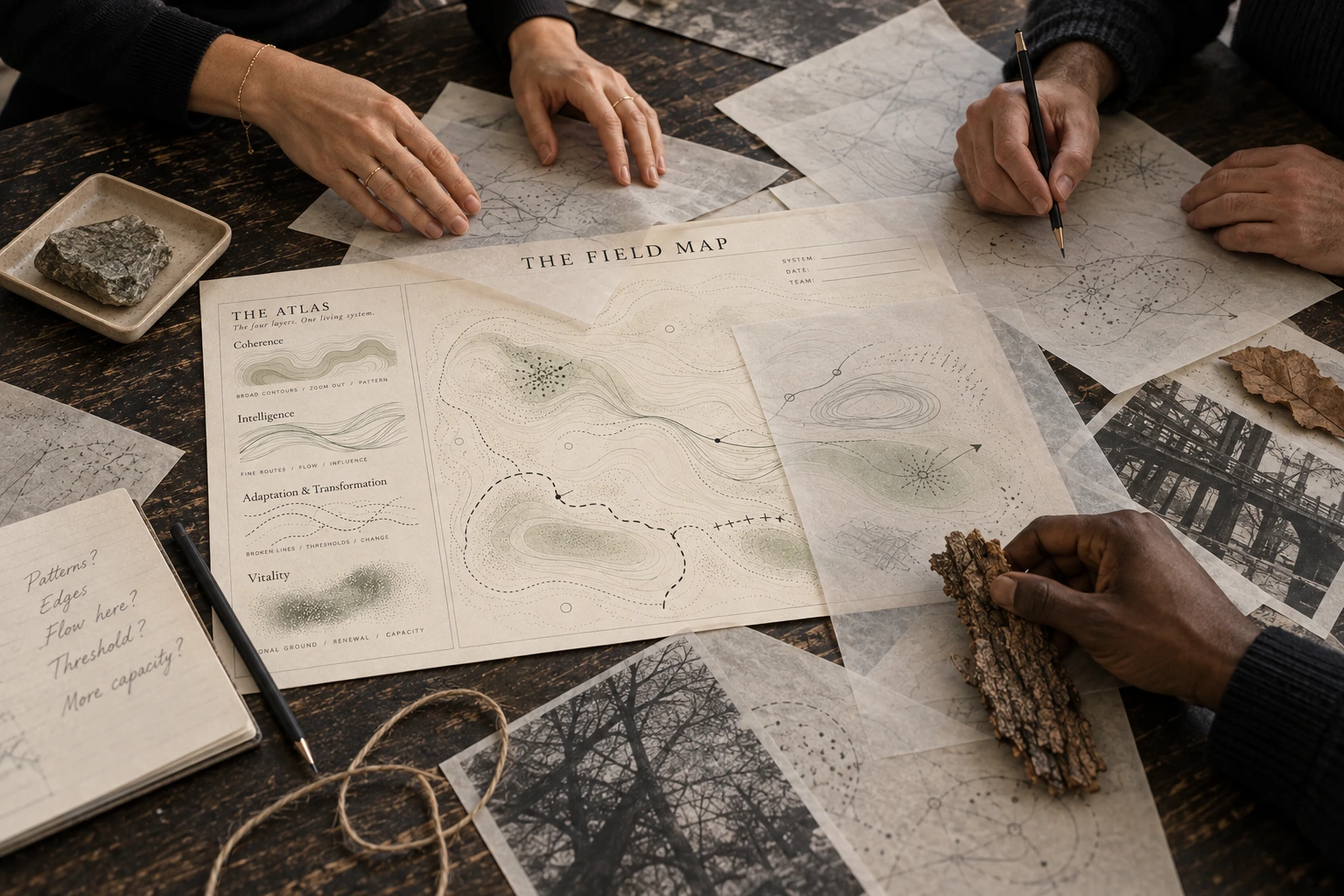
The Field combines analysis and dialogue with observation, movement, and sensory attention. What people can explain, what they notice, and what they experience each offer insight into how the system works.
Through these different ways of knowing, leaders and teams recognize patterns, question familiar interpretations, and explore where change can begin.
The Living Systems Lens
Four connected domains guide our inquiry.
SYSTEM
What holds the system together?
Shared identity, purpose, relationships, and boundaries. What enables people to coordinate around what matters, and where that connection breaks down.
How does the system perceive, make sense, and use what it knows?
How information travels, whose knowledge is heard, and how different perspectives and feedback inform decisions.
How does the system sustain and renew itself?
The conditions supporting energy, participation, and recovery. What sustains the work, what depletes it, and where renewal is needed.
How does the system respond to change, and what needs to change within it?
How people experiment and adjust, and when progress requires a deeper shift in assumptions, structures, or direction.
The foundations of the method
The Field brings living-systems theory and systems thinking into dialogue with phenomenology and embodied practice. These perspectives help us explore how organizational patterns form and how people perceive, experience, and shape them.
The method is grounded in our experience both leading within global organizations and advising leaders and teams through growth, change, and transformation.
Explore the thinking behind The Field →The experiential arc
Encounter
Meet the environment and the situation with fresh attention.
Sense
Notice what draws attention through observation, movement, and bodily experience.
Inquire
Compare perspectives and explore the questions emerging.
Make Meaning
Connect observations to organizational situations and test interpretations.
Experiment
Try different responses and identify what to test in practice.
Integrate
Translate learning into choices and agreements, then revisit what happens.
The group moves back and forth between these stages as understanding develops. Returning to the environment with new questions is part of the process.

A different way into your work
What would you like to understand more clearly about how your team leads, relates, or works together?
Start a conversationWhat would you like to make possible?
Tell us what’s happening in your team, group, or organization and what you’d like to explore.